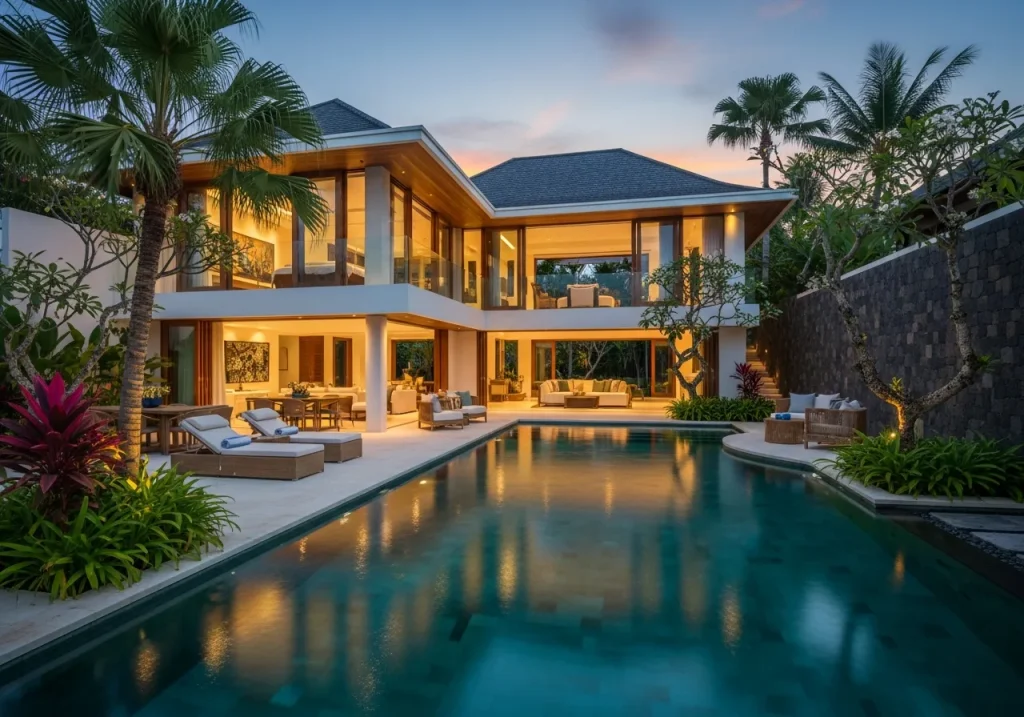
Bali resort residences offer foreign investors a unique opportunity in a rapidly expanding market. Legal ownership structures for Bali branded residences involve considerations of leasehold and freehold titles, foreign investment laws, and the operational frameworks of hotel-managed properties.
Legal Ownership Structure for Bali Resort Residences
Understanding the legal ownership structures available for Bali branded residences is critical for foreign and domestic investors. Indonesia’s property laws, particularly in Bali, present specific frameworks for foreign ownership that differ from many Western jurisdictions. This section details the primary ownership models for branded villas Bali, Bali branded villa residences, and Bali branded apartments, alongside the regulatory environment for Bali branded condo and Bali branded luxury property investments.
Foreign Ownership Regulations
Foreign individuals cannot directly own freehold land in Indonesia. However, various legal structures facilitate long-term property control and investment. These structures are designed to comply with Indonesian agrarian law while providing secure investment avenues for foreign capital in Bali branded real estate.
- Hak Pakai (Right of Use): This title grants a foreign individual the right to use land for a specified period, typically 25 years, renewable for extensions of 20 and 30 years. It is a common structure for Bali branded residences for sale, offering a secure, long-term interest in the property.
- Hak Sewa (Leasehold): Foreigners can lease property directly from an Indonesian landowner for an agreed period, often 25 to 30 years, with options for extension. This is a prevalent model for Bali branded resort property and branded residences Indonesia Bali, particularly for Bali branded beachfront residences.
- PT PMA (Foreign Investment Company): A foreign-owned company established under Indonesian law (Perseroan Terbatas Penanaman Modal Asing) can hold Hak Guna Bangunan (Right to Build) and Hak Guna Usaha (Right to Cultivate) titles. This structure is typically employed for larger Bali branded residential projects, Bali branded villa projects, and Bali hospitality branded residences, allowing for direct ownership of buildings and long-term land rights by the corporate entity.
Leasehold vs. Freehold in Bali Branded Residences
While direct freehold (Hak Milik) ownership is restricted for foreign individuals, the effective control and investment returns from leasehold and Hak Pakai structures for Bali branded residences investment are substantial. Bali branded resort villas and Bali hotel managed residences are frequently offered under these long-term lease arrangements.
Leasehold (Hak Sewa):
- Duration: Typically 25-30 years, with options for extensions. Total lease periods can often reach 80-100 years.
- Security: Lease agreements are legally binding and can be registered, providing security of tenure.
- Transferability: Leasehold interests are transferable, allowing for secondary market sales of Bali branded residences.
- Investment Scope: Suitable for individual investors and family offices targeting Bali branded villa investment and Bali branded apartments.
Freehold (Hak Milik) through PT PMA:
- Mechanism: A PT PMA can hold Hak Guna Bangunan (HGB) or Hak Guna Usaha (HGU) titles, which grant rights to construct and operate on land for up to 30 years, extendable for 20 and then 30 years. This provides effective long-term control akin to freehold for the corporate entity.
- Complexity: Requires establishing and maintaining a legal entity in Indonesia, involving ongoing compliance and reporting.
- Suitability: Preferred by funds and larger institutional investors for significant Bali branded resort property developments and Bali branded real estate portfolios.
Operational Models for Bali Hotel Branded Residences
Bali luxury branded residences often operate under hotel management agreements, which dictate the use, maintenance, and rental of the property. These agreements are central to the investment proposition for Bali branded residences Indonesia, offering professional management and access to global booking networks.
Hotel Management Agreements
These agreements are a standard feature of Bali branded residences, particularly for Bali hotel branded residences and Bali hotel managed residences. They outline the responsibilities of the brand operator and the owner, covering aspects such as:
- Rental Pool Participation: Owners typically place their units into a rental pool managed by the brand, sharing in the revenue generated. This is a key feature for Bali branded residences market investments.
- Maintenance and Upkeep: The brand manages all aspects of property maintenance, ensuring standards are met and preserving asset value.
- Owner Usage Rights: Agreements specify the periods during which owners can occupy their units for personal use, balancing investment returns with lifestyle benefits.
- Brand Standards: Units are maintained to the specific brand’s luxury standards, which contributes to the price premium associated with branded products.
Market Dynamics and Growth of Branded Residences Bali
Bali’s branded residences segment is still relatively small but is growing quickly off a low base, supported by tightening rental regulations and strong tourism-driven demand. Branded products command sizeable price premiums and are increasingly concentrated in a few key coastal hubs, with the market expected to roughly double in scale over the next decade.
Market Size and Growth (2025–2027)
As of March 2025, Bali’s hospitality‑managed real estate market comprised 59 projects with 3,643 units. By early 2026, this had grown to “over 70” hospitality‑managed developments actively on sale. Within this, branded residences account for:
- ≈15% of total hospitality‑managed supply as of March 2025.
- ≈10% of active supply by early 2026 (i.e., units currently being marketed/sold).
These shares imply:
- Total hospitality‑managed units (early 2026) are likely 4,200–4,500 units (extrapolating from 3,643 units in 59 projects in 2025 to “70+” projects in 2026; inference based on average project size).
- Branded residences thus represent on the order of 400–650 units actively in the market, meaning a niche but material segment (inference from 10–15% share).
Growth Drivers
- Global branded residences sector is a $30+ billion annual segment, with ~700 projects worldwide and ~12% annual growth.
- Bali is recognized as one of the emerging Asia-Pacific hotspots and has seen branded residence inventory rise from 13% to ~18% of total hospitality‑managed supply in one year, according to the C9/Horwath series (2024–2025 to 2025–2026).
- JLL‑referenced data suggests Bali hotel and hospitality investment reached about $830 million in Q1 2026 for Bali Province, with analysts expecting the branded niche to roughly double by 2030.
Given these data points, a reasonable working view for 2026–2027 is:
- Annual growth in Bali branded residence inventory: high single‑digits to low double‑digits (in line with ~12% global sector growth and recent local share gains).
- By 2027, Bali is likely to have 80–90 hospitality‑managed developments, with branded residences accounting for approximately 750–850 units.
What You Get with Bali Branded Residences Investment
Investing in Bali branded residences offers a comprehensive package beyond property ownership. This includes:
- Premium Property: Access to luxury properties developed and maintained to international brand standards.
- Professional Management: Hassle-free ownership through established hotel management companies, covering operations, maintenance, and rental.
- Rental Income Potential: Participation in a rental pool designed to generate returns from tourist demand.
- Owner Privileges: Access to hotel amenities, services, and sometimes global loyalty program benefits.
- Secure Legal Framework: Structured ownership models (leasehold, Hak Pakai, PT PMA) designed for foreign investors.
- Capital Appreciation: Exposure to Bali’s growing luxury real estate market and the increasing demand for branded products.
Who This Is For
Bali branded residences are suitable for a specific investor profile seeking both lifestyle benefits and robust financial returns in a dynamic market:
- Investors: Individuals and groups seeking a professionally managed asset with income-generating potential and exposure to a growing luxury tourism market.
- Family Offices: Entities looking to diversify their portfolios with tangible, income-producing assets in a stable, high-demand leisure destination.
- HNW Buyers: High-net-worth individuals desiring a luxury holiday home in Bali that also serves as an investment, managed by a reputable hospitality brand.
- Funds: Investment funds focused on hospitality, real estate, or emerging markets seeking to capitalize on Bali’s increasing prominence in the global luxury travel sector and the expanding branded residences market.
Comparison of Branded Residence Types in Bali
| Feature | Branded Villas Bali | Bali Branded Apartments | Bali Branded Condos |
|---|---|---|---|
| Unit Size (Approx.) | 200–1,000 sqm+ | 50–200 sqm | 60–250 sqm |
| Privacy Level | High | Moderate | Moderate |
| Maintenance Complexity (Owner) | Low (managed) | Low (managed) | Low (managed) |
| Initial Investment (Approx.) | USD 1.5M – 10M+ | USD 300K – 1.5M | USD 400K – 2M |
| Target Market | Luxury families, groups | Couples, small families | Couples, small families |
| Common Locations | Uluwatu, Canggu, Seminyak | Jimbaran, Sanur, Nusa Dua | Jimbaran, Sanur, Nusa Dua |
Frequently Asked Questions
1. Can foreigners own property freehold in Bali?
Foreign individuals cannot directly own freehold (Hak Milik) land in Indonesia. Foreign ownership is facilitated through long-term leasehold agreements (Hak Sewa), Right of Use titles (Hak Pakai), or by establishing an Indonesian foreign investment company (PT PMA) which can hold Hak Guna Bangunan (HGB) titles.
2. What is the typical lease duration for Bali branded residences?
Initial lease durations for Bali branded residences typically range from 25 to 30 years, with contractual options for extensions that can extend the total tenure to 80-100 years. These extensions are usually pre-agreed and stipulated in the initial contract.
3. How do hotel management agreements work for branded residences?
Hotel management agreements are contracts between the individual property owner and the hospitality brand. They detail the brand’s responsibility for managing the property, including operations, maintenance, marketing, and inclusion in a rental pool. Owners typically receive a share of the rental revenue and have specified periods for personal use.
4. What are the key benefits of investing in Bali branded residences?
Key benefits include professional property management, access to a global brand’s booking network, potential for rental income, personal use of a luxury property, and exposure to capital appreciation in Bali’s growing luxury real estate market. The established legal frameworks provide secure investment avenues for foreign capital.
For further details on specific legal structures, investment opportunities, or to discuss your requirements for Bali branded residences, book an investment consultation on WhatsApp or email [email protected]. Our advisors provide specific, factual guidance for foreign and domestic investors in the Bali branded residences market.